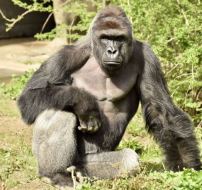
While the Orlando killing of 49 plus people at a gay night club haunts our daily life, I am dedicating this entry to the sting of the death of Harambe, the silverback gorilla at the Cincinnati Zoo. Sad and tragic as the death of the gorilla is, it is quickly lost in the Orlando Florida mass killings. Violence is everywhere. Heartfelt condolences and sadness to the families, Orlando our country for this tragedy.
Back to animal welfare; it is sad to learn of the death of Harambe. The mixed feeling shared by many and considerations for ways to avoid something like this happing again, its on the minds of conservationists.
What is the role of zoos and why do we keep animals captive the way that we do? The Denver Zoo hosts millions of people each year. Zoos are extremely popular. Indeed, my wife and I took our children to the Denver Zoo many time in the 1980’s. As our children have children, they too take their kids, our grand children to the zoo, or at least they did until a few years ago. Their annual membership has lapsed, in part, out of a growing concern regarding the ethics of caging animals. Younger people are changing their view about zoos.
Is there a better way for inspiring a sense of wonderment about the animal kingdom and commitment towards habitat and animal conservation? Many believe there is and a growing movement argue it doesn’t include caging animals in zoos.
There was a time when I personally didn’t think it mattered. I chalked it up to collateral damage. So much good came out of seeing elephants in a 10 acre enclosure it didn’t matter that they experienced severe food and leg disorders due to waking on hard pack. So the monkeys were in a cage bored with existence, so the tigers sprayed the viewing glass behind where I gazed in to their exhibit. Tigers seemed agitated. So what? I was of the opinion that the harm done to caged animals was far outweighed by the experience of seeing live exotic animals in zoos. Seeing those animals triggered a humane response in young and old, a concern for conservation that seemed to be a fair exchange for the pain of life suffered in zoos. No more. Like my past apologies for the use of a billhook as the legitimate tool for managing elephants, I have changed my opinion. I’ve changed my mind after observing and participating in animal care for eighteen years.
I have learned from conservation biologists, human/animal connection professionals, shelter administrators, people growing up in the generation and with Louis Leakey, as well as the current team of people I work with in Africa, I’ve learned why many individuals are changing the way we view animals.
Animals are legal things. They are not “persons” nor do they have rights but they should be recognized as living, thinking, tool using beings, with language, self-recognition and advanced cognition capabilities. Just because we humans don’t speak their language, live in their living room, eat their preferred foods, like what they like, etc., doesn’t mean they should be treated as less than living thinking beings.
Animals don’t have rights, but should they have something? Do they deserve more status than a cracker box zoo existence? A new movie Unlocking the Cage takes a provocative look at our ethic for caging animals. I personally hope it has the same effect on the public as the film Blackfish had on attendance at Sea World.
So, why have animals in captivity: 1) to rehabilitate them for release back into the wild, 2) because they are so injured they cannot survive in the wild, 3) for reintroduction programs for endangered species, 4) confiscated animals that no longer have the skills (and will not acquire them) for release back into the wild. The idea, however, that zoos will maintain populations of animals in captivity in case they are some day needed for reintroduction is fast coming to a close. The captive programs are failing, which is why the zoos are trying to revamp their Species Survival Programs into a new iteration called SAFE: Saving Animals From Extinction.
Animals are sentient beings. They have emotions, they feel pain, they seek to live in they way they are created. If we honor what is on this frail blue dot, we should recognize we need to be better caretakers.
I am dismayed by comments in the press that we take care of animals the way we do because we are on top of the evolutionary heap. Another reasoning cited in the opinion pages and comments by readers is that God created the animals for human use. The justification that humans can exploit the planet without boundaries of consideration of consequence hold sway and is the dominate attitude. Scary really.
# # #





 Ambassador Nehemiah Rotich (MBS), the Chairman of ANAW’s Board of Directors, has vast experience in environmental and biodiversity conservation and management, post-conflict environmental reconstruction and access benefit sharing. His most recent national position was as the Chairman of the National Taskforce on Wildlife Crime. His rich career includes former director of the Kenya Wildlife Service; Senior Programme Officer- United Nations Environment Programme (UNEP), Head of Biodiversity, as Ambassador/ Permanent Representative, Kenya Mission to UNEP and Chief Executive of the East African Wildlife Society. He has also been the Chairman- Board of Directors, Eastern Africa Environmental Network. Among his notable awards is as the recipient of the 1999 Presidential Award of the Order of Moran of the burning spear (MBS) for distinguished service in conservation
 Josphat Ngonyo is ANAW’s Founder and Executive Director. He holds over 15 years experience in wildlife conservation, serving in various capacities in wildlife circles. Some of his national appointments include member of a Ministerial Task Force charged with formulation of an Animal Welfare Policy and the review of the Prevention of Cruelty to Animals Act (cap 360) and also, member of the National Steering Committee involved in the review of the wildlife conservation and management policy and legislation. He is a past Executive Director for Youth for Conservation; Honorary Warden of the Kenya Wildlife Service, member of the Global Task Force for Farm Animal Welfare and Trade, member of the United Nation’s Food and Agriculture Organization’s Gateway to Farm Animal Welfare editorial board. Mr. Ngonyo is hands-on in animal welfare and conservation matters, working closely with communities living with animals.
 Kahindi Lekalhaile is ANAW’s wildlife advisor. His job experience in nature conservation spans 25 years working as a naturalist, environmental education expert, trainer in wildlife social work, field research scientist, ecotourism expert, university lecturer, community-based conservation advisor and senior program manager. Some of his past experience includes assisting to set up the Samburu Elephant Research Centre under Save The Elephants charity in Africa under the supervision of the world-famous expert, Dr. Iain Douglas-Hamilton; executing the United Nation’s Monitoring the Illegal Killing of Elephants (MIKE) program in Kenya covering the northern Kenya elephant population, which is the largest elephant free-ranging elephant population living outside any protected area in East Africa and pioneering the ‘PIKE’ technique (Proportion of Illegally Killed Elephants) as an early warning system for elephant ivory poaching in the world. A renowned crusader against illegal global trade of wildlife and wildlife products, Mr. Lekalhaile is an Earthwatch Fellow in Madagascar and the recipient of the 2006 Disney Conservation Hero award from Disney World.
 not already been made. Because of his legacy he speaks like no other U.S. President could. It is remarkable that as a guest he was so calm and authentic in addressing corruption, politicians who are reluctant to leave office, and the cost of cronyism to middle-class Kenyans. Kenya loses 250,000 jobs to corruption annually. He spoke about the importance for encouraging entrepreneurialism, education, especially for girls and the importance for creating a strong civil society. Frankly, as I read the Daily Nation newspaper when living and working in Kenya, I think President Uhuru Kenyatta is working diligently to clean-up his cabinet putting six of the highest ranking people on administrate leave until investigations for graft are completed. This is a first for a Kenyan President. Times are changing.

 David's Blog
