Embark on a once-in-a-lifetime journey to Kenya with our meticulously crafted trip, featuring three exhilarating safaris and immersive cultural exchanges centered around conservation and habitat protection. If Kenya has been lingering on your bucket list, seize the opportunity now to prepare for this extraordinary adventure. Hurry, as we can only accommodate fourteen guests for this exclusive experience.
For $6,980, indulge in an all-inclusive package covering transportation, accommodation, and most meals, ensuring a hassle-free and unforgettable expedition. What sets this visit apart is our unique collaboration with conservation experts, providing unparalleled insights into efforts to safeguard Africa’s iconic wildlife.
Join us as we delve into the heart of Kenya’s natural wonders and cultural richness, guided by those at the forefront of environmental preservation. Visit www.girostours.com for more details. Feel free to contact me at david@girostours.com.
Full Send Bike Ranch has changed its name to Shadow Mountain Bike Ranch. Don’t be confused, it is the same group helicoptering in at the expense of wildlife, and a valley never fully cultivated by a tractor, complete with riparian watershed. Today it is pristine, tomorrow it is a parking lot. I enjoy bike riding, but this project is a plague to nature.
My friends are gathering names on a petition to oppose the mountain bike development. The developers are taking similar action encouraging mountain bike enthusiasts to sign their petition. Full Send has filed their pre-application/intent with Jefferson County Planning and Zoning. The debate is on.
I don’t have anything against mountain biking but there are 1,000 miles of terrain available today with new sites opening like the Argo Mine bike venue in Idaho Springs. Why commercialize 273 acres of pristine valley and Conifer Mountain for a for profit venture? This is an extreme bike venue which only a small percentage of mountain bike riders participate in anyway.
The problem is the State of Colorado owns the land and for a small price will consider leasing it for any venture that will turn a fragment of revenue to be distributed to public education. The enabling law is part of the state constitution. The authority of the Colorado Land Trust was amended in 1996 to require some consideration for the protection of natural settings and conserve Colorado’s landscapes for future generations. The jury is still out on how responsive and accountable the CLT is to its new direction, i.e., now 26 years ago.
This bike park isn’t compatible with the character of the community. Why build a parking lot for three hundred or more cars, promote daily turnover in that parking lot for six hundred car trips, build a lodge in the valley and construct a ski lift? Sure, neighborhood kids can use the park if their parents fork over the lift cost estimated to be $50 to $70 a day.
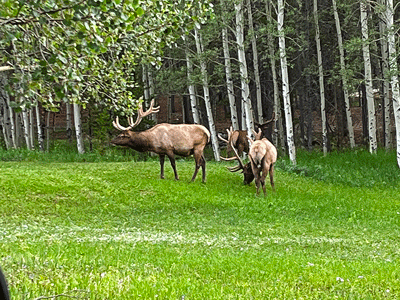
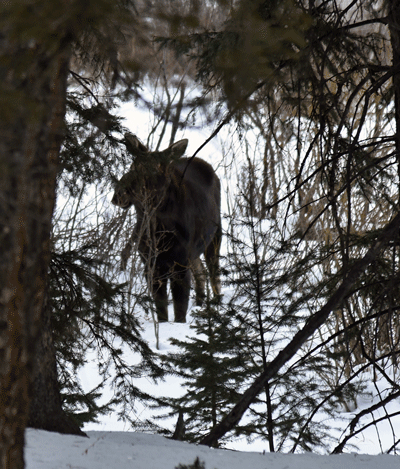
Elk and now moose use the corridor for food and shelter. Located adjacent to Mt Evans Wilderness, the site is recognized for biodiversity. Indeed, these 273 acres are listed by the Nature Conservancy for high topoclimatic variability and low levels of human modification. This provides for species diversity worthy of protection. Furthermore, it is a calving area for elk and deer as well as nest area for birds and numerous other non-human life scurrying around the forest floor.
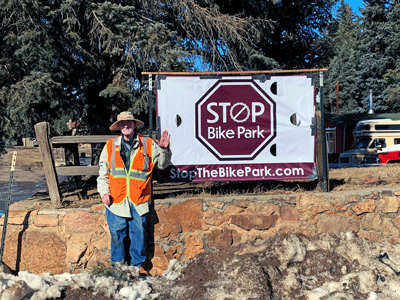
We continue to post signs like this one pictured above and ask everyone concerned for wildlife, biodiversity, water diversion, pollution, highway safety, and fire protection/evacuation to join our cause. Please sign the petition and stay in touch.
For the animals and our children, save something for the next generation.
I recall on my Kenya trip to the Africa Network for Animal Welfare in March of 2015 Kahindi Lakalhaile introducing me to fourteen newly installed Guardians at Kasigau. It was a delight to meet Jones Mwandango, Elisha Sogha, Joshuah Nuttu, Charles Mwamreta, Philisier Kale, Joseph Mwinzi, Jackson Mwanguo, Johathan Kimbulu, Jesicah Njeri, Japhred Maguerga, Benson Kalague, Mgrrius Tamanyasi, Alex Mwashauwa, and Vincent Mwangogo. Early on, under Kahindi and Jos Ngonyo’s leadership, team members were called “Rangers.” They were tasked with patrolling 55,000 acres of community land between National Park Tsavo East and Tsavo West looking for poachers and out-of-town leaseholders whose cattle were illegally grazing in the National Park. The team didn’t like being referred to as Rangers, the common term for such work. The team preferred being called “Guardians.” This positive, more friendly title characterized the community spirit and goodwill these workers for the Africa Network for Animal Welfare embraced.
December 2020 on the job in Kenya
I was delighted to meet with these young people and working with the ANAW group raising funds for their uniforms, flashlights, radios, and general equipment.
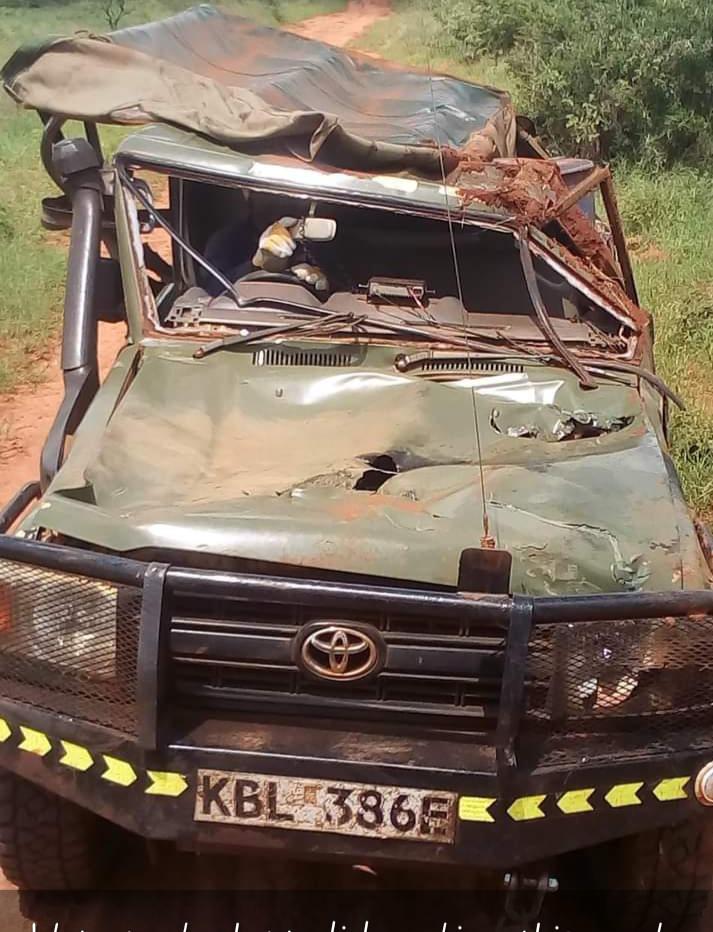
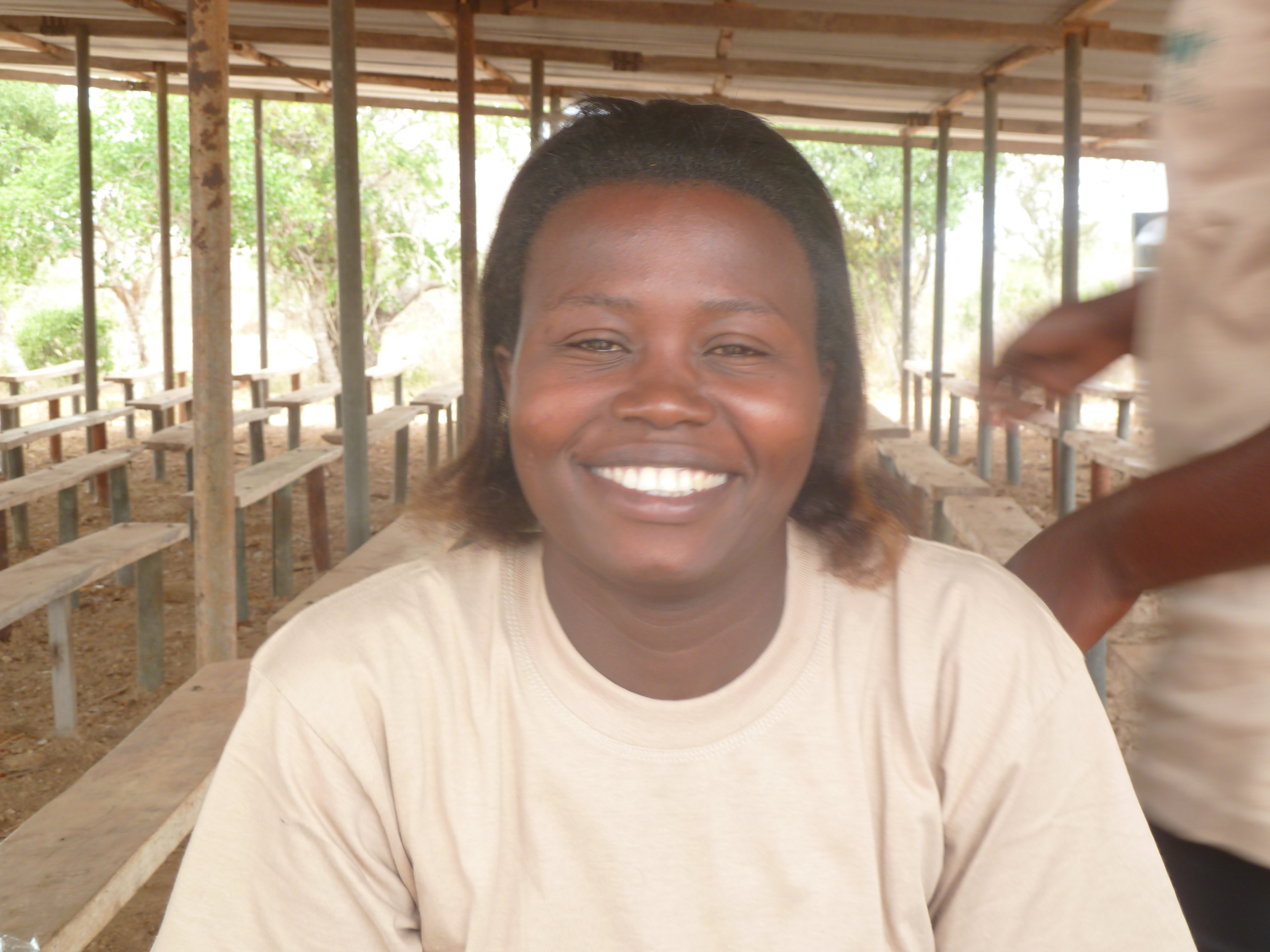
One star in the group was Jesicah Njeri, who also distinguished herself in winning track and field honors in the community. Jesicah matriculated to Wildlife Works and began work there as a Ranger. I don’t know when Jesicah began her new job, but the sad tragedy is she lost her life this month attempting an animal rescue, trampled by an elephant. A stampeding mother elephant rolled her vehicle three times. Three or four other workers were traveling in the vehicle. While the others escaped, some with serious injuries, Jesicah unfortunately did not.
We mourn this tragic loss and send our condolences to family, friends, and co-workers.
What is ANAW doing to protect threatened species & habitat during COVID-19; Does it matter?
In conjunction with Colorado Gives Day, ANAW-USA is holding a virtual event on Tuesday, December 8, 2020, at 5:00 PM Mountain time. The event is scheduled for 90 minutes. This promises to be an interesting and informative event motivated by those of us in the United States committed to sharing insights and partnering with advocates in East Africa, notably Kenya and the Africa Network for Animal Welfare.
The event organizers are keying off the theme of One Health and the notion that all life is linked in ways that affect each other. This has relevance to Kenya because bushmeat consumption has increased due to the pandemic. The pandemic is linked to China and the consumption of wildlife meat. China, Kenya, and the United States, indeed the total global community are linked in the economic downturn resulting from COVID-19.
So what exactly is meant by “animal welfare” and how does this matter to a grassroots organization, ANAW in Nairobi, and volunteers and advocates living in the U.S., ANAW-USA.
If you are interested in a distraction from our country’s Democratic Debates and the Washington D.C. drama check this out from our friends in Kenya.
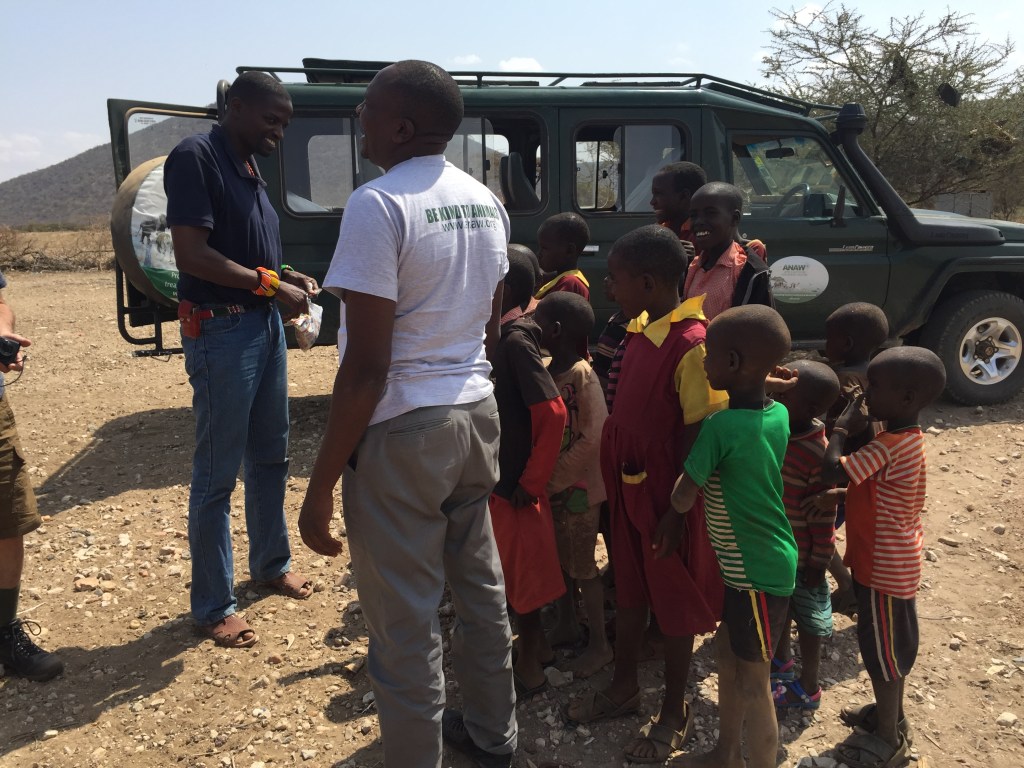
Kahindi Lekalhaile with Africa Network for Animal Welfare staff presenting humane education to local school children
Kahindi Lekalhaile and Josphat Ngonyo continue to educate the public about the brutal and destructive emergence of donkey skin trade in Kenya and the broader continent of Africa. Beasts of burden are important for fetching water, firewood, and all sort of chores necessary to live in rural Africa. As recently as 2015 there are as many as 1.4 million donkeys in Kenya. Changes in the law now allow the use of Donkeys for food, for human consumption. Donkey meat can be sold in the grocery store as a source of animal protein. The sale and consumption of donkey meat is bring about a shortage of donkeys as well as the growing a black market to supply four butcheries in Kenya.
The loss of donkeys through rustling and thievery is becoming critical. This recent interview on Kenya television is worth the preview if you are curious or interested in how many people in Africa get on with and without in their day-to-day lives.
Thank you ANAW for the interview bringing this message to a broader audience.
ANAW in Kenya continues to make a difference for the country by promoting conservation and habitat protection. Its accomplishments include the creation of humane education programs for 44 of Nairobi’s schools as well as experiential trips for visiting graduate students from the United States, United Kingdom, and China. Significantly ANAW has guided the way for collaboration with other NGOs and the United Nations promoting the adoption of conservation and animal care best practices throughout East Africa.
ANAW-USA is a Colorado based organization with volunteers throughout the U.S. partnering with friends in Kenya. Together, a One Health approach has been adopted to assist African communities to create conservation initiatives, leading to economic development benefitting the sustainability of non-human populations as well as humankind. ANAW works to do both, to be human and to be kind.
Now, during this time of the Colorado Giving Day, wherever you live, please consider making a contribution to ANAW. Your gift, of any amount, will be increased through a $1.5 million Incentive Fund. It will make a difference for people and it will make a difference for animals in Kenya.
On my Facebook Page, I promised to share the September 2018 Newsletter written by the Africa Network for Animal Welfare staff in Nairobi. Here is the link below.
I am grateful for the contributions made to ANAW during this holiday season. The campaign is still open. Also, I want to say “thank you” to all who participated to support the employment of the young people in East Africa and their accomplishments for animal welfare, conservation, and habitat.
Mike Coffman lost his bid for re-election to the congressional district where I live. He was “my congressman”. I have heard Mike speak on many occasions and appreciate his efforts for finding solutions to health care and veteran services. This work isn’t easy.
I also appreciate his setting himself apart from the national leadership. Distance from Donald Trump, in Colorado anyway, was a required strategic move. Regrettable, even this tactic didn’t work to save the election for Mike Coffman. It was indeed a referendum against President Trump.
Mike Coffman deserve a big “thank you” from the constituents in Colorado. You sought to create middle ground. Unfortunately, there was none. It is disheartening that the Republican Party pulled financial support from your campaign in the last lap of the campaign. It made it more difficult to win. Perhaps they saw the handwriting on the wall. It is now obvious Coloradoans don’t like the direction Trump is taking the country.
I wish Mike Coffman could have avoided the negative sentiment that has spilled over into his political career. He deserves better. So for one, thank you for your service.
Congressional District 6 was lost not because Mike Coffman failed to serve but because the Republican Party has failed to do its job. We can only hope for better from the Democrats. For now, it feels like our politics is broken, dark and leaderless. The country deserves better.
Congratulations to Jason Crow. We are all in this together.
Maryanne Kagai ANAW’s veterinarian posts the following to the organization’s bulletin board:
It is with great sadness that Ol Pejeta Conservancy and the Dvůr Králové Zoo announce that Sudan, the world’s last male northern white rhino, age 45, died at Ol Pejeta Conservancy in Kenya on March 19th, 2018 (yesterday). Sudan was being treated for age-related complications that led to degenerative changes in muscles and bones combined with extensive skin wounds. His condition worsened significantly in the last 24 hours; he was unable to stand up and was suffering a great deal. The veterinary team from the Dvůr Králové Zoo, Ol Pejeta and Kenya Wildlife Service made the decision to euthanize him.
Sudan will be remembered for his unusually memorable life. In the 1970s, he escaped extinction of his kind in the wild when he was moved to Dvůr Králové Zoo. Throughout his existence, he significantly contributed to survival of his species as he sired two females. Additionally, his genetic material was collected yesterday and provides a hope for future attempts at reproduction of northern white rhinos through advanced cellular technologies. During his final years, Sudan came back to Africa and stole the heart of many with his dignity and strength.
“We on Ol Pejeta are all saddened by Sudan’s death. He was a great ambassador for his species and will be remembered for the work he did to raise awareness globally of the plight facing not only rhinos, but also the many thousands of other species facing extinction as a result of unsustainable human activity. One day, his demise will hopefully be seen as a seminal moment for conservationists world wide,” said Richard Vigne, Ol Pejeta’s CEO.
Unfortunately, Sudan’s death leaves just two female northern white rhinos on the planet; his daughter Najin and her daughter Fatu, who remain at Ol Pejeta. The only hope for the preservation of this subspecies now lies in developing in vitro fertilisation (IVF) techniques using eggs from the two remaining females, stored northern white rhino semen from males and surrogate southern white rhino females.
Animal 24-7 reports the known detail of Esmond Martin’s violent death as I posted last week. Here are the detailed accounts about efforts of the conservation movement in East Africa. Merritt and Beth Clifton describe and write this long article on the current circumstances surrounding Martin’s death. Thank you, Clifton’s for the investigation and ongoing information.






 David's Blog